Dragon Wars Referee Training Course
MODULE OVERVIEW
The best referees are not remembered for how many whistles they blow, they are remembered for how well they control the match.
Game control is the ability to:
Manage emotions
Maintain fairness
Prevent escalation
Keep players safe
Control momentum
Lead with calm authority
This module teaches Dragon Wars referees how to manage players, coaches, and high-pressure moments before problems become chaos.
A strong referee recognizes danger early, communicates clearly, and creates an environment where players can compete safely and confidently.
MODULE OBJECTIVES
By the end of this module, referees will be able to:
✅ Control player emotions and match intensity
✅ Use body language to establish authority
✅ Use whistle tone and timing effectively
✅ Communicate with confidence and calmness
✅ Handle emotional coaches professionally
✅ Recognize warning signs before conflict escalates
✅ Use de-escalation strategies during tense moments
✅ Prioritize player safety at all times
WHAT IS GAME CONTROL?
Definition
Game control is the referee’s ability to:
Keep the match organized
Maintain fairness
Prevent emotional escalation
Protect players
Manage momentum
Strong Game Control Looks Like:
Calm communication
Quick recognition of tension
Consistent foul recognition
Strong positioning
Confident body language
Early intervention
Poor Game Control Looks Like:
Players arguing constantly
Coaches yelling uncontrollably
Retaliation fouls
Emotional decisions
Referee hesitation
Loss of authority
PRESENCE & BODY LANGUAGE
“Your Presence Speaks Before You Do.”
Body language affects authority immediately.
Players and coaches read confidence instantly.
Strong Referee Body Language
Strong Presence Includes:
✅ Standing tall
✅ Eye contact
✅ Calm movements
✅ Sharp signals
✅ Purposeful walking/running
✅ Confident posture
Weak Referee Body Language
Weak Presence Includes:
❌ Slouching
❌ Nervous gestures
❌ Avoiding eye contact
❌ Overreacting emotionally
❌ Looking uncertain
❌ Arguing excessively
Referee Positioning & Presence
Good positioning:
Improves credibility
Helps decision-making
Shows involvement
Poor positioning:
Creates doubt
Increases complaints
Weakens authority
WHISTLE CONTROL
The Whistle Is a Communication Tool
Your whistle communicates:
Urgency
Authority
Confidence
Control
Types of Whistle Use
Light Whistle
Used for:
Simple restarts
Minor fouls
Routine stoppages
Strong Whistle
Used for:
Hard fouls
Dangerous play
Escalating situations
Long Firm Whistle
Used for:
Stopping confrontation
Ending halves
Gaining immediate attention
Common Whistle Mistakes
❌ Weak whistle tone
❌ Delayed whistle
❌ Excessive whistle use
❌ Emotional whistle reactions
DRAGON WARS PRINCIPLE
“A confident whistle prevents arguments.”
VOICE COMMANDS
Preventative Communication
Great referees talk before fouls happen.
Effective Referee Commands
Control Commands
“Easy!”
“Play smart!”
“Keep it clean!”
“Watch the hands!”
“No pushing!”
Restart Commands
“Wait for the whistle.”
“Back up.”
“Move ten.”
“Play on!”
Conflict Commands
“Enough.”
“We’re done.”
“No more.”
“Walk away.”
Voice Command Standards
Strong Communication Is:
✅ Loud enough
✅ Calm
✅ Short
✅ Clear
✅ Confident
Weak Communication Is:
❌ Emotional
❌ Screaming constantly
❌ Unclear instructions
❌ Over-explaining
MANAGING AGGRESSIVE BEHAVIOR
Recognizing Escalation Early
Strong referees recognize warning signs BEFORE conflict erupts.
Warning Signs of Escalation
Players:
Harder tackles
Trash talking
Retaliation
Arguing after calls
Shoving
Coaches:
Constant complaints
Aggressive tone
Leaving technical area
Emotional reactions
Early Intervention Strategies
Preventative Actions
✅ Verbal warnings
✅ Strong whistle tone
✅ Calm player conversations
✅ Quick foul recognition
✅ Slowing the game down
Managing Physical Games
Sometimes matches become emotionally intense.
Referees must:
Increase communication
Tighten foul standards
Stay close to play
Watch retaliation carefully
MANAGING AGGRESSIVE BEHAVIOR
Recognizing Escalation Early
Strong referees recognize warning signs BEFORE conflict erupts.
Warning Signs of Escalation
Players:
Harder tackles
Trash talking
Retaliation
Arguing after calls
Shoving
Coaches:
Constant complaints
Aggressive tone
Leaving technical area
Emotional reactions
Early Intervention Strategies
Preventative Actions
✅ Verbal warnings
✅ Strong whistle tone
✅ Calm player conversations
✅ Quick foul recognition
✅ Slowing the game down
Managing Physical Games
Sometimes matches become emotionally intense.
Referees must:
Increase communication
Tighten foul standards
Stay close to play
Watch retaliation carefully
HANDLING EMOTIONAL COACHES
Coaches Influence Match Atmosphere
A calm coach helps players stay calm.
An emotional coach can escalate an entire game.
Referee Approach to Coaches
Stay Professional
Never argue emotionally.
Listen Briefly
Allow short communication, but maintain boundaries.
Use Calm Authority
Examples:
“Coach, I saw it.”
“That’s enough.”
“We’re moving on.”
“Please stay in your area.”
When Coaches Cross the Line
Warnings May Be Needed For:
Persistent complaints
Public dissent
Aggressive behavior
Escalation Process
Verbal warning
Formal warning
Removal if necessary
IMPORTANT
Referees should NEVER:
❌ Insult coaches
❌ Yell emotionally
❌ Threaten unnecessarily
❌ Engage in personal arguments
DE-ESCALATION TECHNIQUES
Calm Referees Control Emotional Games
De-escalation means lowering tension before conflict explodes.
De-Escalation Tools
1. Calm Voice
Lower your tone instead of raising it.
2. Slow the Moment
Take time before restart if emotions are high.
3. Separate Players
Prevent retaliation or confrontation.
4. Use Presence
Move quickly toward conflict areas.
5. Use Clear Commands
Examples:
“Walk away.”
“Enough.”
“We’re done here.”
What NOT To Do
❌ Match player anger
❌ Argue emotionally
❌ Overreact publicly
❌ Humiliate players
PROTECTING PLAYER SAFETY
Safety Is Always Priority #1
Dragon Wars referees protect players first.
Dangerous Play Includes:
Reckless tackles
High kicks
Elbows
Violent conduct
Retaliation fouls
Referee Responsibilities
Strong referees:
✅ Stop dangerous behavior early
✅ Punish reckless actions consistently
✅ Watch emotional players carefully
✅ Protect injured players immediately
Injury Management
If injury occurs:
Stop play if serious
Call trainers/coaches if needed
Create space around injured player
Stay calm and organized
MATCH TEMPERATURE
Reading Match Temperature
Every game has emotional intensity.
Referees must constantly evaluate:
Player frustration
Coach emotions
Crowd tension
Physicality level
Match Temperature Levels
Green Zone
Calm
Respectful
Controlled
Referee Style:
Relaxed management
Yellow Zone
Increased fouls
Frustration rising
More complaints
Referee Style:
More communication & tighter control
Red Zone
Aggression
Retaliation
Confrontation risk
Referee Style:
Immediate intervention & strict discipline
REFEREE LEADERSHIP COMMANDS
Dragon Wars Leadership Vocabulary
These commands help establish authority and control.
Core Referee Commands
“Play on!”
Use:
Advantage situations
Fair physical play
“Easy!”
Use:
Escalating physicality
Early warning
“Back up!”
Use:
Free kick management
Player spacing
“No more!”
Use:
Persistent misconduct
Emotional behavior
“I saw it.”
Use:
To reduce complaints
Show awareness
IMPORTANT
Delivery matters more than volume.
Strong referees sound:
Calm
Controlled
Certain
CONFIDENCE UNDER PRESSURE
Mistakes Will Happen
Every referee misses calls sometimes.
What matters is:
Recovery
Confidence
Composure
Strong Referees:
✅ Move on quickly
✅ Stay mentally focused
✅ Avoid emotional reactions
✅ Continue communicating confidently
Weak Referees:
❌ Panic after mistakes
❌ Lose confidence
❌ Begin guessing calls
❌ Overcompensate emotionally
DRAGON WARS LEADERSHIP PRINCIPLE
“Players trust calm leaders under pressure.”
Discussion Questions
Why is body language important for referees?
1
What causes games to escalate?
2
How can referees stop conflict early?
3
What makes players trust referees?
4
Dragon Wars Referees Must:
✅ Communicate clearly
✅ Stay calm under pressure
✅ Use strong body language
✅ Prevent escalation early
✅ Protect player safety
✅ Lead with confidence and consistency
“The best referees don’t wait for chaos.
They prevent it.”
HOMEWORK ASSIGNMENT
Match Observation Challenge
Watch a live or recorded game and identify:
3 moments of strong game control
2 escalation warning signs
1 example of effective communication
1 example of poor referee management
Reflection Questions
Did the referee control emotions well?
How did communication affect the game?
What would you have done differently?

MODULE COMPLETION REQUIREMENTS
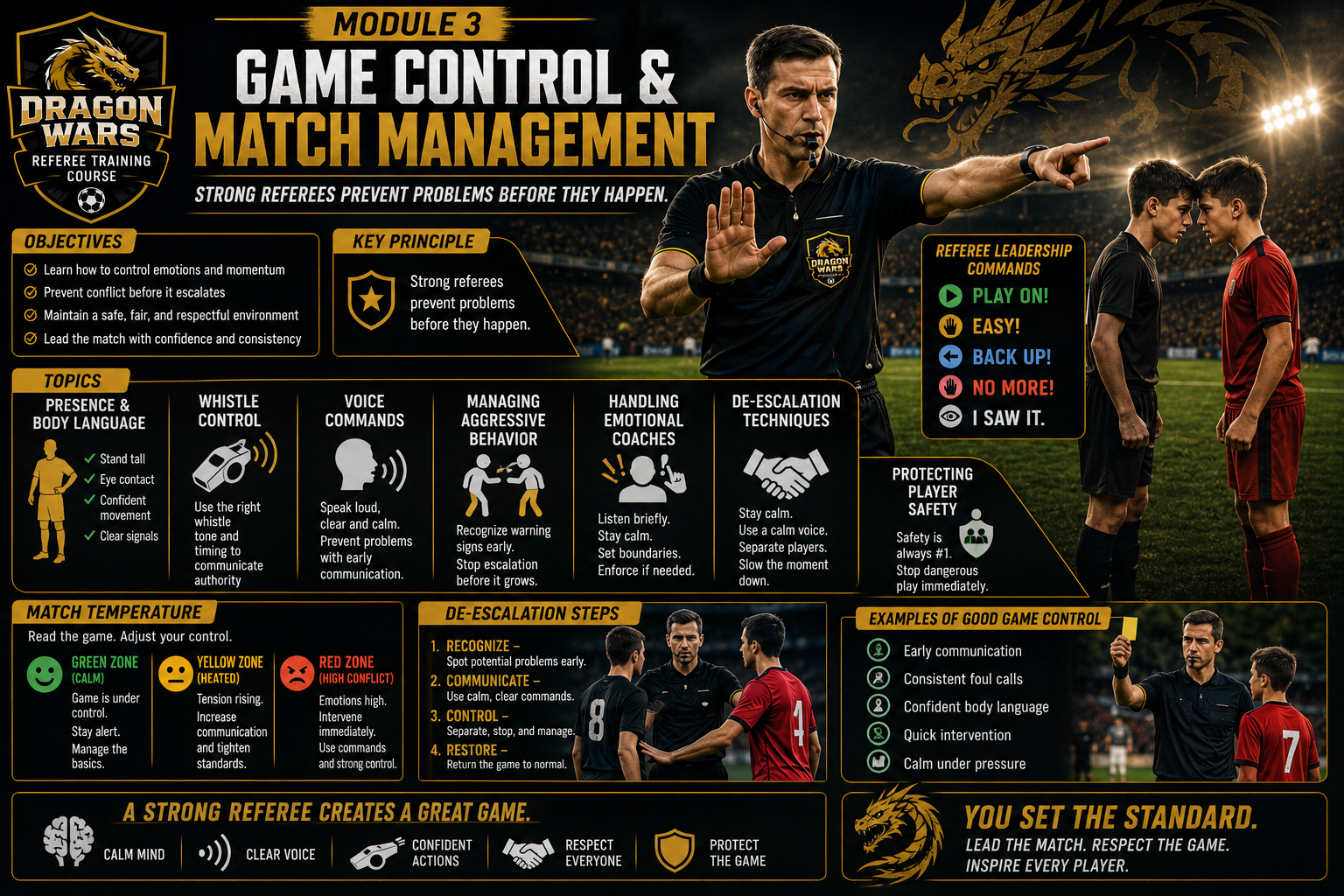
To complete Module 3, referees must:
Demonstrate strong whistle technique
Use leadership voice commands correctly
Pass conflict management scenarios
Show proper body language
Demonstrate calm leadership under pressure